
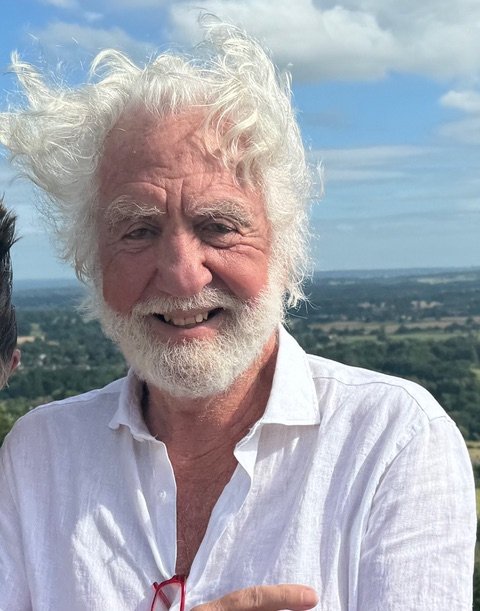
Professor Emeritus, Design and Regenerative Futures, RMIT University
Personal Link:https://academics.rmit.edu.au/chris-ryan2
For me, looking back, it seems almost that the concept of Field-Stations for the Future has been clear for a very long time.
But, let’s start with the name.
Our decision to use the term field-stations, for places to catalyse regenerative futures, was taken with the understanding that there would be broad familiarity with the concept, that it would transcend language and cultural differences across many countries.
The term has been widely used since the 19th Century to describe a place to acquire knowledge from observation or experimentation ‘in the field’, based at an outpost or ‘station’ connected to institutions of research and education. Over time, field-stations became more than places for research, they changed the image of science. The scientist in the field was portrayed, almost romantically, as an adventurer, understanding the world through immersion in its more-than-human dimensions. That contrast with the precise, objective ‘white-coated scientist’ back at the laboratory became a symbolic representation of a growing epistemological divide as to how the world should be understood. Laboratory knowledge approached the world through controlled experimentation, isolating particular aspects of a larger system; field-science emphasised immersion and context, observing – from within – the full complexity of a system as it actually operates.
In some domains of knowledge production, like agriculture and forestry (or more recently in urban studies), the field station became more than a place to collaborate with nature, it required that researchers collaborated with others whose knowledge derived from lifetimes of living and working within the environment in focus. This approach values cooperative experimentation and indigenous knowledge.
The term field-station has sometimes been replaced by the idea of ‘real-life laboratories’ (a deliberate blurring of the field/laboratory distinction).
The path to Field-stations of the Future
My own work at RMIT and Melbourne Universities (often in collaboration with other members of this network), has revolved around the creation of field-stations that entwine virtual and place-based experimentation. This work connects to a strand of participative design focused on the co-production of future imaginaries – in our case for governments, companies and communities faced with significant environmental challenges to current patterns of living.
These imaginaries can be thought of as virtual field-stations; they become a territory for virtual experimentation – the exploration and visualisation of alternative life-systems (human and non-human) that might be more resilient in the face of emerging challenges.
For over a decade (from 1990) that co-design futures work focused on the transformation of systems of production and consumption of manufactured goods – to reduce their negative life-cycle environmental and social impacts. Our collaborators were industry, government, universities and, particularly designers and design students.
In 2003, surveying more than a decade of such work around the world (to produce ‘green goods’ and green, circular, systems of production, I was genuinely optimistic:
“In …not much more than a decade, the theory, practice and potential of designing-out the life-cycle environment impacts of manufactured products seems to have become well understood and accepted. There are eco-design rules [that] can reduce the whole-of-life environmental impacts of products by … 60-75%, within current market conditions….. ‘Expanding the sphere of eco-products’ is now an explicit goal of environment and industry policy in most OECD countries, a goal supported by most major industry groups and environmental activists.” (i)
We had proposed the setting up of a form of field-stations for the amplification of this eco-design and eco-innovation development. Under the title ‘EcoLabs’, (ii) we argued for a new form of innovation hub; it would have some of the characteristics of the best design labs in companies, but these EcoLab field-stations were to be established within the public sphere as drivers of new products and new production/consumption infrastructure. In these spaces, industry would be just one collaborative partner with university researchers, design practices, NGO’s and consumers. The concept gained traction in Europe/UK and the US (though we were quickly made aware that “EcoLab” was a trademark of a global health protection company).
In Melbourne Australia the concept was taken up by our state government, with a large multi-year grant to establish a collaborative ‘public laboratory’ bringing together the design schools of four universities (RMIT, Melbourne, Monash and Swinburne). In 2006 this became the Victorian Eco-Innovation Lab (VEIL), based at the University of Melbourne.
By the time VEIL was established, the optimism I had expressed above had to be tempered. It had becoming evident at a societal level that, everywhere, the reductions in environmental impact per product were being overwhelmed by economic growth derived from the consumption of consumer goods. Increasingly, those consumed goods had shorter and shorter (useful) lives. Sophisticated design approaches for circular material cycles based on long-life and repairable products and components (aiming to reduce overall material extraction and processing) was already narrowing to simple design for materials recycling and, as we now see so clearly, even that goal was frequently thwarted by the sheer volume of discarded (waste) goods. We were truely entering the new waste-age.
The economic crisis of 2008 severely dented the innovation appetite of the business sector (one of our bigger programs with Electrolux was put on hold). Much of industry now viewed eco-design and eco-innovation as a cost rather than an investment in securing their future competitive edge. Governments (in part reflecting the aspirations of their citizens as expressed at the ballot box) became reluctant to pursue policies and regulations that would compel producers to accept responsibility for the full environmental impacts their products. In the triple-bottom-line model for sustainable development, we entered a period where the economic seemed always to win out (with the environmental and the social impacts deferred until some future economic or technological development).
At that time, the challenge of climate change and the increasing urgency for action on decarbonisation and resilience emerged as the most significant factor in negotiating sustainable futures.
By 2010, VEIL instigated a new climate-focused program, EcoAcupuncture. focused on the transformation of urban life (towns and cities) responding to multiple interconnected factors:
- The central role of urban life in the shaping of patterns of consumption of goods and services (structurally and culturally determined);
- The significant contribution of cities to global carbon pollution
- The rapid urbanisation of global population.
In 2016 we reported (iii) on VEIL’s action-research focused on cities, highlighting the concept of virtual experimentation, as a particularly potent domain for transformative change. Eco-Acupuncture was defined as a “design approach to catalyse action in the context of rapidly emerging and disruptive challenges to the fabric and life of cities”. As a methodology it focused first on the co-production of new (25 year horizon) urban imaginaries, “evoking the critical human ability to conceptualise alternative realities, to imagine and to explore in the mind other sets of relationships (social, physical, technological) than those currently evident in the lived-in world.”
Dealing with climate-change meant cities and towns faced the need for rapid and fundamental – revolutionary – transformation of established physical-technological-social-cultural systems, Urban ’systems of provision’ had been shaped historically around an expectation (an envelope) of climate variation that could no longer be expected to hold. As we said then: If this revolutionary period happens without major social dislocation and contestation it will be because of creative innovation, an acceptance of uncertainty and ambiguity as a condition of knowledge, and an engagement with the idea and value of experimentation as a social, cultural and economic objective.
For us, the possibilities of virtual experimentation was the first part of the answer to a looming societal question: how can we stimulate enough experimentation, rapid experimentation, to deal with the pace and the scale of climate related change?
In answering that question, we understood we needed another, second, phase of our eco-acupuncture program, the most obvious connection with the metaphor of ‘acupuncture’: Future imaginaries, even if collectively negotiated and visualised, ultimately need to be evidenced in some material form that could demonstrate new systems possibilities. (Remember the Domus magazine tag line – ‘Unless ideas are massaged into reality they evaporate’!)
Our work with communities and cities required that the co-imagining of specific future possibilities was accompanied by the identification of many (often small) places available for intervention in the existing fabric of urban life. These became our urban ‘acupuncture points’. The locally specific new imaginaries were then interrogated to co-design ‘future prototypes’ of new living-systems to be realised at those intervention points.
Ideally those designed interventions reflected the systems transformations that the collectively-imagined futures had visualised. In practice, because those intervention spaces were generally limited in space – and because their specific climate-related challenges were often dependent on their location within the wider urban fabric – their prototyping-capacity was usually limited to parts of the wider systems of provision. But, viewed as a network of interventions and future-prototypes, their potential to catalyse urban transformation, the objective of the eco-acupuncture program, derived from the degree to which they could be seen as parts of a connected whole. The issue was to find ways to make them connected, conceptually and practically, for local inhabitants. The hope was that they would be encountered – and understood – through the daily movement of people.
In retrospect, although there were some great successes, the catalytic objectives required more resources than our program had available. Two particular lessons were clear:
- The first seemed to be evident from many of the intervention points. It could be simply stated as: the way to ensure that future-prototype interventions were encountered enough for them to have impact, was to make their construction part of a collective community effort, or as we would express it in this context – to build community agency through collective action to demonstrate new potentialities.
- The second lesson was about the ways conceptual agency and disempowerment was vulnerable to the hegemony of power.. This was illustrated most explicitly in a follow-on national program focused on rapid climate mitigation scenarios for the southern Australian capital cities by 2040. (vi). After four years of work with many hundreds of people we had visions of futures for those cities organised around four scenarios. When we polled the participants about their favoured scenarios (with visualised outcomes), the most favoured were generally the ones they saw as the least likely. That led us to summarise what we saw as a ‘future cognitive dissonance: “The future that people hope for is seen as moving further and further from the future that people expect to encounter”
That is what started me thinking about ways to counter feedback loops of disempowerment; ways that could be scaled through a shared network of regenerative action and regenerative connection.
(i) Ryan C. Learning from a Decade (or So) of Eco-Design Experience (pt One). Journal of Industrial Ecology Vol. 7, No 2 MIT Press 2003.
(ii)Ryan C. EcoLab – A jump towards sustainability. (Part 1) Journal of Industrial Ecology Vol. 5, No 3 MIT Press 2002.; Ryan C. EcoLab – Learning from the information technology revolution. (Part two) Journal of Industrial Ecology Vol. 5, No 4 MIT Press 2002.
(iii) Chris Ryan, Idil Gaziulusoy, Kes McCormick, Michael Trudgeon 2016.Virtual City Experimentation: A Critical Role for Design Visioning. Chapter in The Experimental City, Evans, Karvonen and Raven. Routledge. April, UK.
(vi) Ryan C., Twomey P., Gaziulusoy I., McGrail S., Candy S., Larsen K., Trudgeon M., Chandler P. (2019) Visions, scenarios and pathways for rapid decarbonisation of Australian Cities by 2040 Chapter in: Decarbonising the Built Environment – Charting the Transition. Eds: Newton,P.; Presard,D. Sproul, A.; White, S. Palgrave Macmillan UK. See also: https://www.ecoacupuncture.com/visions-and-pathways-2040
Leave a Reply